Essay No. 01 · Geopolitics

What If Israel
Just Disappeared?

A thought experiment about the vacuum left behind—and the regional system hiding beneath a question that sounds deceptively simple.

By First Principles24 min read
Begin the essay
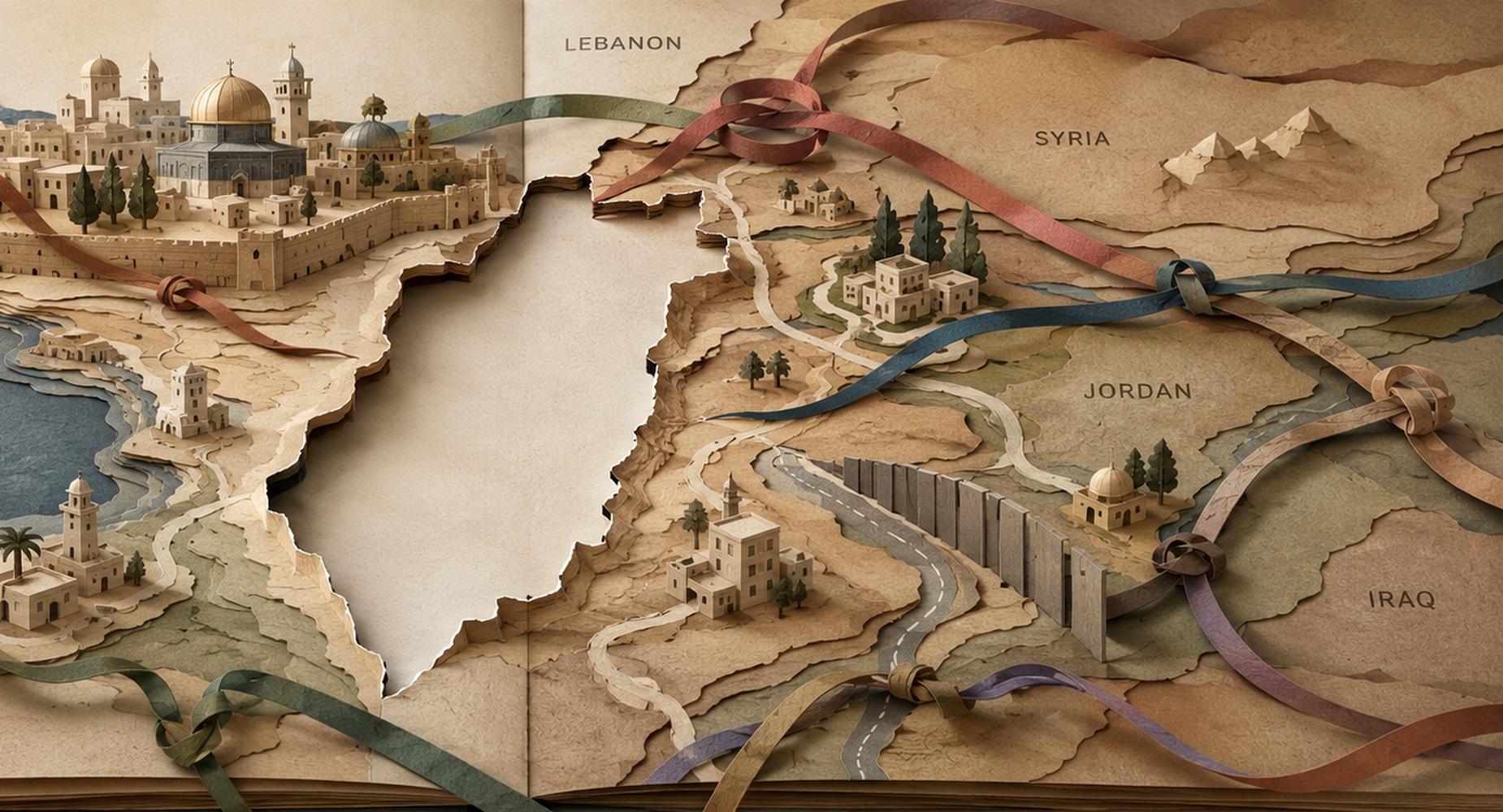
A layered paper-cut map of Israel and its neighbours, with Israel removed to expose the empty space and the regional ties around it

Complex things, made clear.

Explanation is not exoneration.

Follow the system, not the slogan.

Act I

The Thought Experiment

No war. No bombs. Just a magic wand. Israel is gone, and only the land is left behind.

Would the Middle East finally be at peace?

The disappearance of Israel would likely create one of the biggest power vacuums in modern history. Palestinian factions would fight over who rules. Iran’s current regime would claim victory and try to shape what happens next. Arab states would compete to stop Iran dominating the outcome. Jerusalem would become even more contested. Millions of Jews would become refugees.

This essay is not arguing that Israel is innocent.

It is not. Israel’s occupation of the West Bank, expansion of settlements, blockade of Gaza and devastating military campaigns have created real grievances.

But this essay asks a different question:

If Israel vanished, would peace follow?

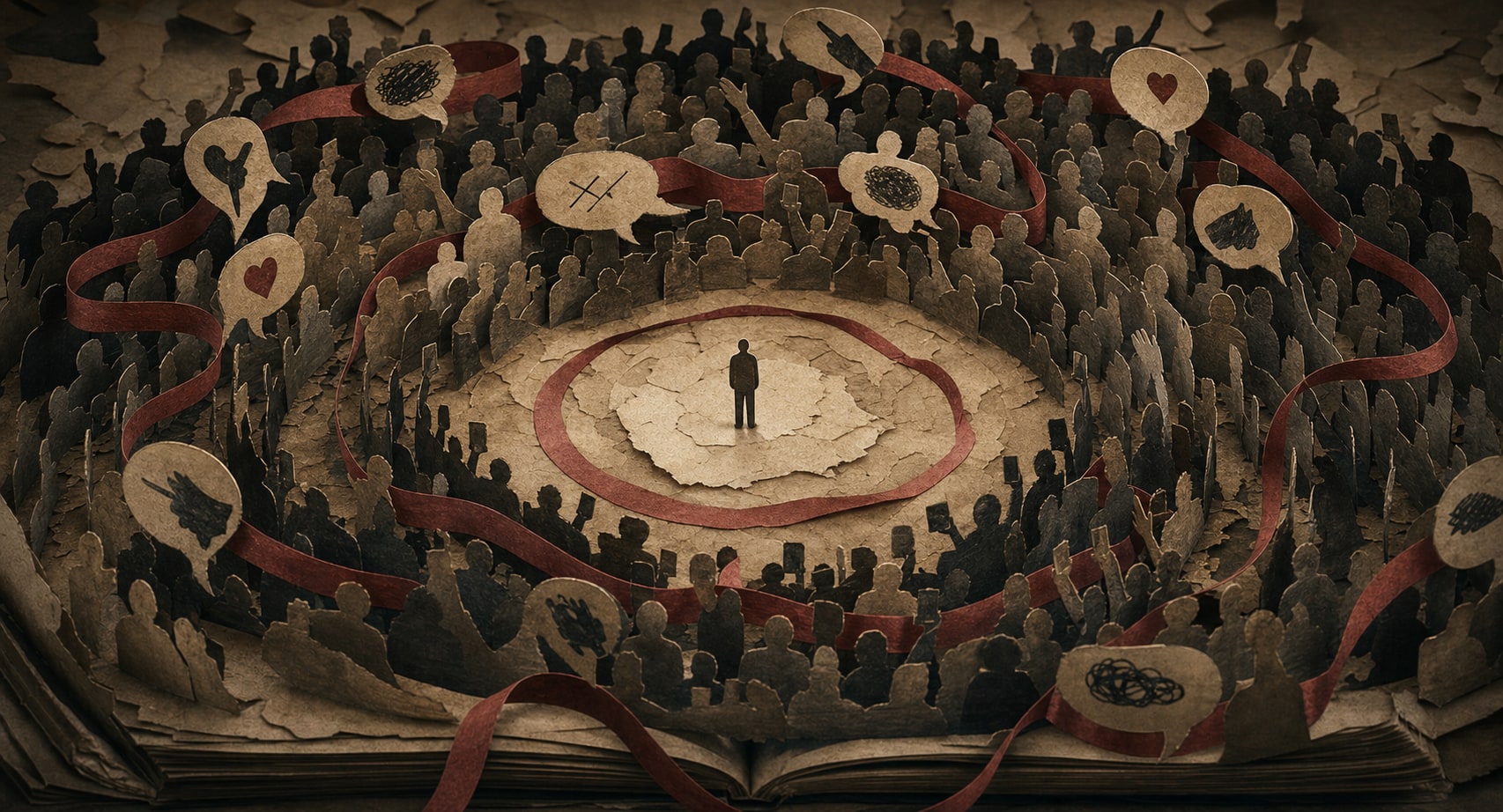
Paper-cut map of Israel surrounded by competing political, military and ideological forces

Who wants Israel gone – and why?

Before we investigate this magical future, it is worth being clear: this is not just fantasy.

There are many people around the world who do, in fact, want Israel to disappear. To cease to exist.

But it would be a mistake to imagine that everyone who opposes Israel is thinking the same thing.

They are not.

Some Palestinians oppose Israel because of displacement, occupation, statelessness, checkpoints, settlements, military rule and the failure to achieve a viable state of their own.

Hamas goes further. It combines Palestinian nationalism with Sunni Islamist ideology. It does not simply object to particular Israeli policies. It has historically rejected Israel’s legitimacy and used armed struggle as its central method. Hamas’s original charter declared that “Israel will exist and will continue to exist until Islam obliterates it.”

Palestinian Islamic Jihad is more narrowly militant and more closely tied to Iran. It is less a state-building movement than a permanent resistance movement against Israel itself. Palestinian Islamic Jihad rejects any political settlement recognising Israel and describes armed struggle as the only path to the liberation of all of Palestine.

Hezbollah’s hostility to Israel is different again. It is tied to Lebanon, Shia politics, Iran’s revolutionary ideology and Hezbollah’s own need to justify remaining an armed state-within-a-state. Hezbollah's 1985 Open Letter calls for "the complete eradication of Israel."

The Houthis in Yemen and Shia militias in Iraq are not primarily Palestinian movements at all. For them, Israel is part of a wider anti-American and anti-Western struggle. Palestine gives them a powerful banner under which to claim moral authority. The Houthis' own slogan, written on their flag, leaves little ambiguity about the movement's worldview: "God is Great, Death to America, Death to Israel, Curse upon the Jews, Victory to Islam."

Then there is Iran.

Iran’s current regime sees Israel as a symbol of the U.S.-led order in the Middle East. Iran has not merely opposed Israel. It has spent decades building a regional system of armed pressure around it. Iran's Supreme Leader has said that "no such thing as the Zionist regime" should exist in the region, while his official website describes the "elimination of the illegitimate Zionist regime" as the official policy of the Islamic Republic.

These groups differ in ideology, religion, tactics and political goals. They do not form a single organisation, and they do not always agree with one another. But on one point, their own words leave remarkably little ambiguity.

And then there are Western activists, some of whom are motivated by genuine human-rights concerns. Some see Israel through an anti-colonial lens, or through an oppressor-versus-oppressed framework in which Israel becomes the ultimate villain. Some cross the line into treating Israel as uniquely evil. Others cross the line into antisemitism.

Their placards — “From the river to the sea”, “End Zionism”, “Resistance is justified” and others — often move beyond criticism of Israeli policy and into questioning whether Israel itself should continue to exist.

It is also worth being clear about one word that is often misunderstood.

Zionism is not a particular Israeli government.

It is not settlements.

It is not the occupation.

It is not Benjamin Netanyahu.

It is not hidden in the details of a particular Israeli policy.

At its simplest, Zionism is the belief that Israel should exist as the national home of the Jewish people.

People can oppose settlements, occupation, military actions or Israeli governments without rejecting that idea.

If Zionism is the belief that Israel should exist, anti-Zionism is, by definition, opposition to that idea.

“End Zionism” placards on Western streets show that the debate has moved beyond criticism of Israeli policy and into questioning whether Israel itself should continue to exist. The idea is no longer confined to the Middle East.

So there is a coalition of different grievances, ideologies and power interests that often point in the same direction. Different motives. One destination: the disappearance of Israel.

The Morning After

Imagine the magic wand has been waved.

Israel has disappeared. The army is gone. The state is gone. The government is gone.

Who rules the land the next morning?

The first fight after Israel disappeared would most likely be Palestinians fighting Palestinians over who gets to rule Palestine.

Palestinian politics is deeply divided. There is Hamas in Gaza. Fatah and the Palestinian Authority in the West Bank. Palestinian Islamic Jihad. Local armed groups. Clans. Exiled factions. Islamists. Nationalists. Foreign-backed actors. It would be messy.

Beyond this, the disappearance of Israel would create a prize. And prizes rarely stay unclaimed for long. Especially when they involve land, weapons, borders, refugees, holy sites, foreign money and international recognition.

While the Palestinians were fighting over who ruled the land, other powers would be watching closely: Egypt, Jordan, Saudi Arabia, Turkey, Qatar, the United States, Europe.

But one power would see the moment more clearly than anyone else.

Iran.

Not because Iran is Palestinian. It is not.

Not because Iran borders Israel. It does not.

Iran’s current regime would not say: “Good, that is finished. Let us now become friendly neighbours.”

It would say: “The resistance won.”

That victory would become a new central myth of the Islamic Republic.

Because Iran’s current regime has spent decades building a regional pressure system around Israel — and it would use Israel’s disappearance to prove that its strategy worked: to fund armed groups, reject compromise, build missiles, resist America, surround Israel, wait long enough, and eventually watch the enemy collapse.

Act Ii

The Machine

Paper-cut regional machine linking conflicts and pressure points around an empty centre

Iran built a machine

Iran did not simply complain about Israel from a distance.

It built a machine around it. Not to win one battle, but to shape every battle that followed.

Since the 1979 revolution, and through the Revolutionary Guard and its Quds Force, Iran has spent decades building what is often called the Axis of Resistance: Hezbollah in Lebanon, Palestinian Islamic Jihad and Hamas in the Palestinian arena, the Houthis in Yemen, armed militias in both Iraq and Syria, and, until recently, Assad’s Syria as a key corridor and state partner.

These groups are not all puppets.

They have their own local motives, politics and rivalries.

But Iran has used money, weapons, training, ideology and logistics to turn separate conflicts into a connected regional pressure system.

Think of it as a series of burning ropes.

Iran did not light every fire.

But it helped tie many of them together — and poured on the fuel.

That is what many people miss.

They see Gaza. Lebanon. Yemen. Iraq. Syria. The Red Sea. Missiles. Militias. Street protests. Slogans.

But they do not always see the network.

The Islamic Republic has spent decades trying to make Israel fight on more than one front, without Iran having to fight directly.

That is the machine.

Its purpose is to make the removal of Israel a realistic objective.

But while Israel is central to Iran’s story, it’s ambitions do not stop there.

The regime seeks regional influence. It wants to reduce U.S. power in the Middle East. It wants to lead what it calls the “Axis of Resistance”. It wants leverage over Arab rivals. It wants deterrence against both Israel and the United States. It wants ideological legitimacy within Iran. Above all, it wants regime survival.

Iran’s hostile activity has not been confined to Palestine, Lebanon, Gaza, Syria or Yemen.

Western security agencies accuse Iran of trying to export intimidation, surveillance, kidnapping and assassination into Europe, Britain, North America and Australia.

But this needs to be understood carefully.

This is not usually ISIS-style mass-casualty terrorism, where the goal is to kill random civilians, create spectacle and spread panic across a whole society.

Iran’s overseas violence is often more targeted.

It is aimed at specific people the regime sees as threats: dissidents, journalists, activists, Jewish or Israeli-linked targets, and officials it wants to punish or silence.

The goal is not only to frighten governments.

It is to frighten particular people — and everyone like them.

One clear example is Masih Alinejad. An Iranian-American journalist and dissident, she has campaigned against Iran’s compulsory hijab laws and the broader general apartheid, human rights abuses, and political corruption of the Islamic Republic of Iran. U.S. prosecutors have alleged Iranian-linked plots to kidnap or kill her in New York. The point was not random terror. It was targeted fear: silence the critic, scare the exile, and warn others that distance does not mean safety.

MI5 said in 2024 that, since January 2022, it had dealt with 20 Iran-backed plots presenting potentially lethal threats to people in the UK. A British intelligence report later warned of multiple attempted murders and kidnappings targeting dissidents and Jewish or Israeli interests.

In 2025, fourteen countries condemned what they described as Iranian intelligence plots to kill, kidnap and harass people in Europe and North America.

In 2024, the U.S. Justice Department charged an alleged Iranian government asset in a murder-for-hire plot targeting President-elect Donald Trump, as well as Iranian-American dissidents and Jewish targets.

Iran denies many of these accusations.

But the pattern described by Western security agencies is hard to dismiss: this is not only a Middle East issue.

For the regime, intimidation is a form of power.

Overseas plots can silence dissidents, frighten journalists, intimidate Jewish and Israeli targets, create bargaining chips, test Western red lines, and show Iranians at home that the regime can reach its enemies anywhere.

It belongs to the same logic as Iran’s proxy strategy: apply pressure indirectly, use deniable middlemen where possible, and avoid a full conventional war where Iran would be much weaker.

Paper-cut scene contrasting everyday Iranian life with the machinery of state repression

Iran’s regime is not Iran’s people

It is important to recognise that Iran’s regime is not the same thing as Iran’s people.

The Islamic Republic has made hostility to Israel central to its identity and regional strategy. But many Iranians are far more concerned with their economy, their freedom and their safety than with seeing their country’s wealth and resources devoted to Hezbollah, Hamas, the Houthis and permanent confrontation with Israel.

That frustration has even appeared in protest slogans such as “Not Gaza, not Lebanon, my life for Iran” — a rejection of the regime’s habit of prioritising regional confrontation over domestic wellbeing.

It is a brave slogan to chant in a country where people have good reason to fear their own rulers.

In late 2025 and early 2026, Iran was shaken by major anti-government protests. The regime responded with live fire, mass arrests, internet shutdowns and widespread violence in the streets. Death sentences and later executions also drew international condemnation.

The exact death toll remains disputed. Early verified counts rose from hundreds into the thousands. Later investigations suggested the true number may have been far higher. The Guardian reported medical and morgue testimony suggesting the toll could exceed 30,000. TIME reported senior Iranian Health Ministry officials saying as many as 30,000 people may have been killed on 8 and 9 January alone.

Because Iran shut down the internet and restricted information, the true number may never be known.

But the pattern is clear.

When Iranians challenged the regime, the regime treated them as enemies.

UN Special Rapporteur Mai Sato warned that the death toll could be in the tens of thousands and supported investigation into whether the crackdown amounted to crimes against humanity. Reports described mass detentions, torture, sexual abuse in custody, bodies disappearing from hospitals, and wounded protesters being transferred from medical care to detention.

This was not an isolated break from normality. It sits inside a wider system of repression.

Women can be harassed, arrested or attacked over compulsory hijab rules. Dissidents, journalists, artists, minorities and protesters can face prison, torture, exile or death sentences. Iran is one of the world’s leading execution states.

The regime does have a real base: the Revolutionary Guard, the Basij (a paramilitary volunteer force often used to police society and suppress protests), parts of the clerical establishment, state-linked businesses and committed ideological supporters.

But it also governs a society with deep alienation and opposition.

Some Iranians support the regime. Many Iranians may also distrust Israel or the West, especially during war. But that is not the same as saying ordinary Iranians want their state’s money spent on regional proxy conflict.

Paper-cut nuclear symbol beneath a protective umbrella on a map of the Middle East

Iran’s nuclear programme

So far, we have covered Iran’s regional machine: proxies, militias, missiles, intimidation and influence.

But there is another layer to this pressure system.

Iran’s nuclear programme.

In 2025, the IAEA (International Atomic Energy Agency) estimated Iran had more than 400 kilograms of uranium enriched to 60%. That is not normal reactor fuel. That is far above the level normally used for civilian nuclear power and much closer to weapons-grade enrichment. The IAEA estimated that, if enriched further, it could be enough material for several nuclear weapons.

For Israel, the United States and many other governments, that fundamentally changes the strategic picture.

The concern is not only that Iran might eventually use a nuclear weapon. It is the confidence that even a near-nuclear capability could give Iran's wider regional strategy, emboldening both the regime and the armed groups it supports. If Iran ultimately acquired nuclear weapons, that effect could become even stronger under the protection of a nuclear deterrent.

Beyond that is the very real risk of a Middle East arms race, more reckless proxy warfare, and the collapse of what remains of the global non-proliferation system. Arab Gulf states have repeatedly expressed concern about Iran's regional ambitions and would face difficult decisions if Tehran acquired nuclear weapons.

That is a serious security argument. It does not automatically prove that every strike on Iran was, or is wise, lawful or effective. But it explains why Israeli and Western strategists see Iran as more than a distant sponsor of trouble.

Paper-cut map showing the region divided by competing interests and balances of power

The Middle East is not united behind Iran

Another common mistake is to imagine “the Middle East” as one bloc: Arabs and Iran on one side, Israel and the West on the other.

It is much messier than that.

Many Arab publics are furious about Palestinian suffering.

But many Arab governments look at Iran and see a different threat: proxies, missiles, smuggling networks, political interference and armed movements that can weaken states from within.

Saudi Arabia, the UAE, Bahrain, Jordan and Egypt may condemn Israeli actions. But they do not want Iran emerging as the dominant power in the region.

They have watched Iranian-backed groups build armies inside other countries, pressure governments, threaten shipping, launch missiles and turn local conflicts into regional ones.

That is not an abstract fear.

Lebanon shows what happens when an armed movement becomes stronger than the state around it.

Iraq shows how militias can gain political and military power without fully answering to the government.

Yemen shows how a local war can become a missile and shipping crisis far beyond its borders.

Even for Qatar and Oman, which often mediate with Iran, that does not mean they want Iran to dominate the region. It is more likely that they fear what happens if the region explodes.

So if Israel disappeared, Iran would not be surrounded by grateful neighbours.

Iran would likely face Arab states trying to stop it inheriting the victory.

Many Arab governments dislike Israel’s actions.

But they may fear Iran’s success even more.

The New Contest

Iran, and its network of burning ropes is at the heart of why Palestine would not become an untouched national homeland if Israel vanished.

Egypt would fear Hamas-style rule and instability near Sinai.

Jordan would fear unrest, conflict over Jerusalem and pressure from its large Palestinian-origin population.

Saudi Arabia and the UAE would want to stop Iran dominating the new order.

Qatar and Turkey might support Islamist-linked factions.

Iran would support the “resistance” camp.

Western states would want stability, anti-terror guarantees and control over escalation.

So Palestine would not become an untouched national homeland.

It would become the prize in a regional contest.

This leads us to one of many uncomfortable truths.

Many powers speak about Palestinians.

Far fewer are willing to let Palestinians freely decide their own future if that future threatens their own interests.

Palestinians are not only victims of Israel. They are also used by Iran, by Arab governments, by armed factions and sometimes by Western political movements.

They are too often treated as pawns in wider conflicts, including by some of the people who claim most loudly to defend them.

Act Iii

The New Middle East

Paper-cut families travelling in different directions across a divided landscape

Another refugee crisis

There is another part of the magic-wand fantasy that is often ignored.

Where do the Jews go?

A serious moral account cannot treat Israeli Jews as temporary visitors who can simply vanish.

Millions of Israeli Jews were born there. Many are descendants of Holocaust survivors. Many are descendants of much older Jewish communities from across the Middle East and North Africa. Many are descendants of Jews who fled or were expelled from Arab and Muslim-majority countries after Israel was created.

The reasons varied by country, but across much of the region a combination of Arab nationalism, repeated wars with Israel, discrimination, persecution and, in some places, the rise of political Islam steadily emptied ancient Jewish communities.

Jews left Iraq, Yemen, Egypt, Libya, Syria, Lebanon, Morocco, Iran and many other places.

Some were expelled. Some fled violence or persecution. Some left because political pressure, discrimination, fear or instability made life feel impossible.

Many ended up in Israel not because they had endless options, but because history had repeatedly shown Jews that safety elsewhere was conditional.

So when people say Israeli Jews should “go back,” the question is: back where?

This does not diminish Palestinian displacement. It does not erase the reality of the Nakba. It does not justify occupation.

It adds another wound.

This land contains two refugee stories, not one.

For many Jews, Israel was not the first stop. It was the place they reached after running out of safe places to go.

Removing Israel would not erase a refugee problem.

It would create another one.

And for many Jews, it would feel less like “leaving” and more like the continuation of a chase that began long before they reached Israel.

Paper-cut breached border with multiple burning paths spreading into a regional conflict

October 7 changed everything

Before October 7, Israel largely tried to manage the threats around it.

It contained Hamas in Gaza. It deterred Hezbollah in Lebanon. It struck Iranian-linked targets selectively. It used intelligence, air power, walls, checkpoints and military dominance to try to control the security environment around it.

This containment strategy was not clean or morally perfect. It involved occupation of the West Bank. Expansion of settlements. Settler violence. Blockade of Gaza. Repeated military campaigns. Unequal rights under occupation. And no credible political horizon for Palestinians.

These things rightly angered Palestinians and many outside observers. They also gave Israel’s enemies powerful material for propaganda.

Nevertheless, containment was the strategy.

Then October 7 happened.

And October 7 matters because this was the moment the disappearance fantasy stopped being only a slogan on a placard.

Hamas could not make Israel disappear as a state. It did not have that power.

But for several hours, in the communities it overran, that is what happened. The border failed. The army was absent. Civilians were murdered. People were brutalised. Hostages were dragged into Gaza. Israeli sovereignty vanished in real places, not as theory but as experience.

Almost immediately, the attack widened into something larger.

On October 8, Hezbollah began attacking from Lebanon.

As the war widened over the months that followed, the fronts multiplied: Hamas and Palestinian Islamic Jihad in Gaza; Hezbollah in Lebanon; the Houthis from Yemen and the Red Sea; Iran-aligned militias in Iraq; Iranian-linked networks and weapons routes in Syria; Iran itself through direct missile and drone attacks; and unrest and attacks from the West Bank and even inside Israel.

These were not seven identical fronts, and they were not all directed from Tehran.

But several belonged to, or were supported by, the wider regional system Iran had spent decades helping to build: armed groups, missiles, drones, smuggling routes, ideology and pressure points around Israel.

Iran did not need to order every attack or control every group like a puppet master.

The system worked because it connected every burning rope.

For many Israelis, October 7 was not just a massacre. It was a warning: if the people who wanted Israel gone ever got the chance, this was what disappearance might look like first — the wall folds down, the state vanishes, and armed men step through.

This is the point where the strategy of containment stopped looking hard-headed and started looking delusional.

This is when the question changed.

Before October 7, the question was: “How do we manage these threats?”

After October 7, the question became: “How do we remove them?”

And as the various attacks on multiple fronts rolled in following October 7, “them” increasingly meant more than Hamas.

For Israel, removing the threat meant degrading the wider Iranian-backed network around it: Hamas and Palestinian Islamic Jihad in Gaza, Hezbollah in Lebanon, militias in Syria and Iraq, the Houthis in Yemen, and ultimately Iran’s missile, drone and nuclear infrastructure.

That shift is understandable.

If armed groups committed to your destruction cross the border, murder civilians and take hostages, the argument for “management” becomes much harder to sustain.

But the new strategy carries its own danger.

Military power can destroy tunnels, commanders and missiles. It can degrade Hamas, Hezbollah and Iranian infrastructure. It can restore deterrence for a time.

But it cannot, by itself, produce legitimacy, reconciliation or a political settlement.

That is Israel’s dilemma.

Containment looks intolerable after October 7. But total military removal of the threat may be impossible if the threat is also fed by ideology, humiliation, occupation, revenge and outside sponsorship.

Paper-cut monument dissolving above a network of regional consequences and possibilities

What if Iran’s current regime disappeared instead?

So given this, let’s now reverse the thought experiment.

What if the current Iranian regime disappeared?

Again, not through invasion. Just a magic wand. The Supreme Leader, the Revolutionary Guard leadership, the clerical power structure and the regime’s ideological machinery are gone.

Would the Middle East then instantly become peaceful?

Iran itself could face a dangerous succession crisis.

Who controls the army? The police? The oil money? The missiles? The nuclear programme? The borders? The prisons? The intelligence files?

The Revolutionary Guard’s senior leadership would be gone. But the organisation beneath it — its officers, units, weapons, businesses and the web of loyalties it had built — would not simply evaporate.

Some commanders might try to rebrand themselves as patriotic defenders of Iran. Some militias might fragment. Some regime insiders might try to survive under a new name. Democratic opposition groups, monarchists, nationalists, ethnic minorities, exiles and ordinary protesters would all argue over what comes next.

But get through all that and the regional effect would be enormous.

Hezbollah would lose its main patron. Palestinian Islamic Jihad would be weakened. Hamas would lose an important source of support. The Houthis would still exist, but with less advanced backing. Iraqi militias would face a crisis of money, direction and legitimacy.

Israel would not become completely safe. The Palestinian issue would still exist. Hezbollah would still have weapons. Hamas or successor groups would still exist. Jerusalem would still be contested. The West Bank would still matter.

But one of the biggest external engines feeding several of the region’s conflicts would be removed.

Lebanon could also be one of the biggest beneficiaries. Hezbollah’s military and financial position would almost certainly weaken, creating more space for the Lebanese state, the Lebanese Army and economic recovery.

Yemen might benefit. The Houthis would not simply disappear. But losing Iranian support could reduce their reach and strategic confidence.

The Gulf states would probably feel some of the greatest strategic relief. Saudi Arabia, the UAE and Bahrain have spent decades trying to contain Iranian regional influence. A weaker missile threat and a diminished proxy network would change their security environment dramatically.

Global shipping could benefit too. Red Sea attacks might decline. Missile threats might recede. Insurance costs could fall. Trade routes could become safer.

None of this diminishes the risk.

The disappearance of the regime would be a major rupture, and it would certainly not produce immediate peace.

But the two thought experiments are not equal.

Israel disappearing means roughly 10 million people lose their state.

Iran’s current regime disappearing means more than 90 million people keep their country but gain the chance to choose a different future.

There is no guarantee that future would be peaceful or democratic.

Iraq, Libya and Afghanistan are not exact comparisons, but they remain warnings that dismantling an old order is easier than building a stable new one.

Even so, removing the current regime would create a rare opportunity. There are no guarantees, but it offers a more hopeful future than one built on permanent confrontation at home and abroad.

Paper-cut regional map tied into a complex knot of interlocking causes

The fantasy of simple answers

The question “what if Israel disappeared?” is useful because it exposes the fantasy at the heart of much anti-Israel politics.

It imagines that one state is the cause of the region’s problems.

The conflict cannot be understood as a simple story of one villain and one victim.

That is especially true if we condemn Israel’s actions while refusing to examine the threats, attacks and rejectionism that have shaped its behaviour.

Understanding those pressures does not excuse Israel’s actions.

Explanation is not exoneration.

But ignoring why Israel behaves as it does does not make the story fairer. It only makes it less true.

The central question is not whether Israel has made mistakes. It plainly has. The central question is whether the region can ever become stable while some of its most powerful movements remain committed to Israel's disappearance rather than its coexistence.

A country surrounded by organisations openly committed to its destruction will inevitably become a heavily militarised state.

Israel's flaws did not emerge in a vacuum. That does not excuse them, but it is not unimportant.

Too often ignored is the fact that the Iranian regime has built something much darker and less understood: a regional pressure system that uses Palestine, proxies, ideology, intimidation and nuclear leverage to expand its power.

It is important to recognise that the Palestinians are not only victims of Israel.

They are also used, in the worst possible sense of the word, by Iran, Arab governments, armed factions and Western activists.

The tragedy is that almost everyone claims to speak for them, while ordinary Palestinians keep paying the price.

Every conflict eventually reaches the same question.

Can the people involved accept that the other side will still exist when it is over?

As long as the answer is no, wars may pause. They may shrink. They may grow. Outside powers may change. Governments may rise and fall.

But peace will remain out of reach.

The thought experiment began by asking:

What if Israel disappeared?

Perhaps that was never the right question.

A more important one is this:

What would happen if Israel were finally accepted as a permanent part of the Middle East?

Because everything we have explored points in one direction.

Removing Israel would not end the conflict.

That would not solve every grievance. Palestinians would still deserve a viable future of their own. But it would remove one of the conflict's most fundamental obstacles: the belief that peace requires one side to disappear.

But accepting that Israel is not going to disappear might finally allow it to begin ending.

So perhaps the final question is this: why, nearly eighty years after its creation, does so much of the debate still begin by imagining that Israel should not exist?

Why First Principles exists

The world is complicated.
Our explanations shouldn’t be.

First Principles looks beneath political arguments to the incentives, histories and systems that make events possible. The aim is not to tell you what to think. It is to make the machinery visible—so you can think with more information and less certainty theatre.